St Nicolas
Newbury
Berkshire
Tuesday, 13 August 2013
Saturday, 25 May 2013
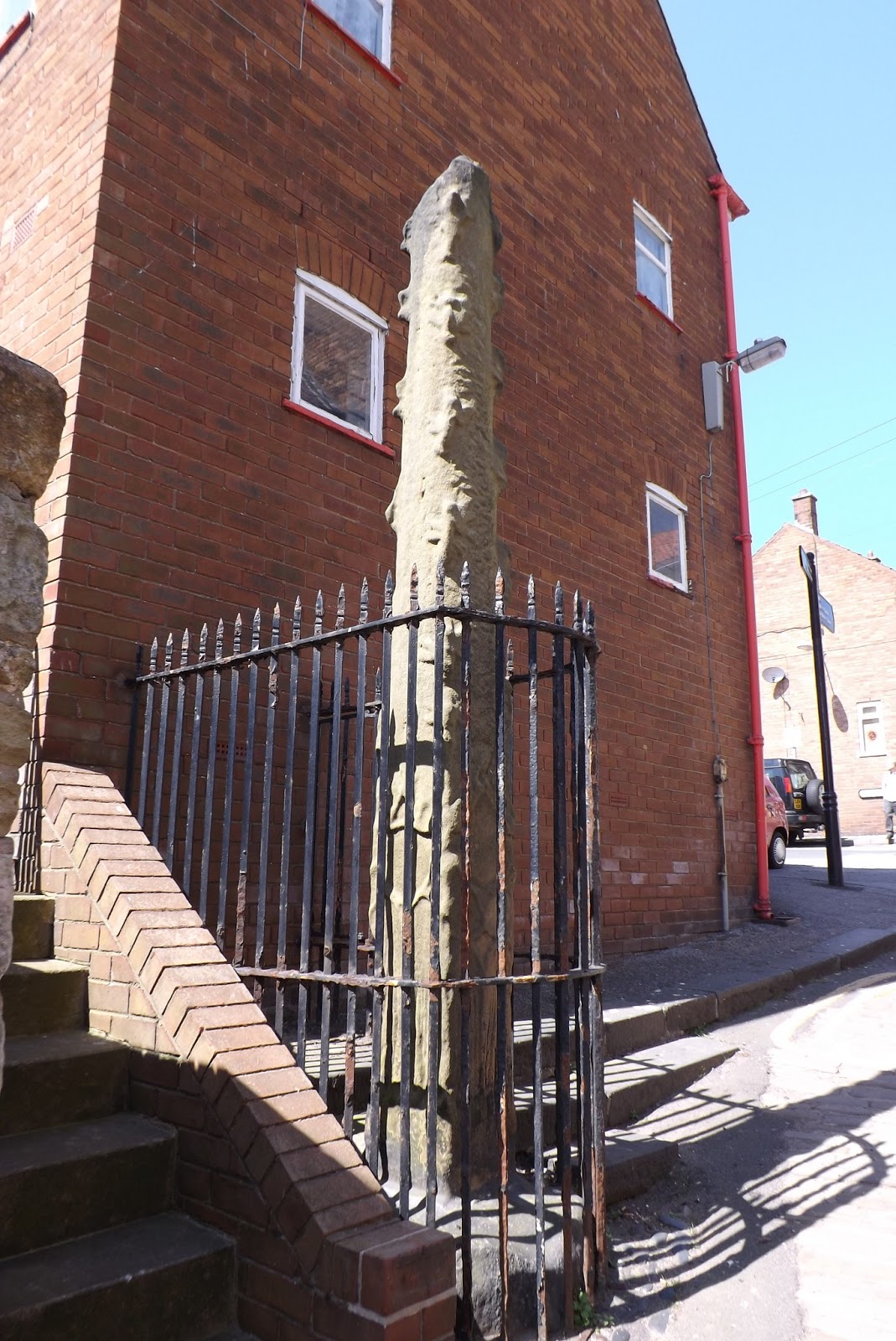
Scarborough, The Butter Cross
The Butter Cross
Scarborough
North Yorkshire
First mentioned in 1547, the Butter Cross could possibly date from the 14th century. Some of the decoration, sadly now very weathered, is similar to crosses and their shafts that have been reliably dated to this period.
The Butter Cross now stands at the junction of Low Conduit Street and St Mary's Street, but would once have stood, complete and with a carved head, in Cross Street. Why it was moved to this spot, hidden away from all but those who accidentally stumble upon it, is beyond me.
Like many towns and villages throughout England, Scarborough originally had more than this single cross. Town documents mention the Haldene Cross, the Corn Cross and the Rede Cross...but sadly these have all since vanished. If you take a closer look, some carved decoration can still be seen, though the stone is very badly weathered.
Monday, 13 May 2013
Whitby, St Mary and Abbey, recent weather damage to cliff face.
St Marys church and Abbey
Whitby
Whitby
Above. View of St Mary with the Abbey in the background. The weather damaged area of East Cliff is now covered with wire meshing.
Above. A wider panoramic view of East Cliff with the church, abbey and weather damage.
Thursday, 21 February 2013
Kendal Parish Church - Restored West window
Kendal
Cumbria
The West window in Kendal Parish church has been restored and placed back in the tower, along with new sand stone uprights. As you can see, the colours are incredibly vibrant......however, due to the location of the organ in the organ loft, it is impossible to properly photograph the window in full. As a result, only some of the panes were visible.....shown here.
Whilst photographing the newly restored windows, I was informed that there are plans to illuminate the windows from inside, so that the full intricate details can be seen from the outside. Obviously this won't be an ideal situation, but it will be much better than the current way the window is viewed. As soon as this is done, I'll post photos here to see how it looks.
Tuesday, 23 October 2012
Oxford churches
Oxford churches
When I visited Oxford in 2012, my wife my little boy and I, picked up a leaflet from the Tourism office on Broad Street. If I remember rightly, the walk was about 3 miles, and is easy walking, taking in many of Oxford's interesting buildings including the churches shown here.
Information on the walk and some of its interesting buildings can be found here.
Here is a good map showing a number of the more interesting buildings that can be found within easy walking distance of the city centre.
Carfax Tower
The only portion of the church of St Martin that survives, is the 12th century tower, sitting at the junctions of St Aldgate, Cornmarket Street, Queen Street and the High Street.
Between 1122 and 1896 the church was the City Church of Oxford, a postion now held by St Michael's at the North Gate. When the main body of the church was demolished (1896) the church lost it's significance to the city.
The church has a peel of bells dating from 1676, and the tower, like at St Michael, is open to the public.
St Michael at the North Gate
This is probably Oxford's oldest building (competing with Oxford Castle's tower), and probably dates from around 1040....a rare pre-Norman structure. The church sits on Cornmarket Street the junction with Ship Street.
The church is built on the site of the original Northern entrance or gate into Oxford, town defences that are now sadly much diminished. William Morris, the pre-raphaelite designer, painter and writer was married here in 1859. St Michael's church holds the position of City Church of Oxford, the church where the Oxford's Mayor and its City Corporation are expected to worship. It is open to the public, and access is available to the summit of the tower which provides great views over the city of Oxford.
There is some interesting information at St Michael's official website.
Wythburn, St John
Wythburn
St John
Cumbria
What a little gem of a church this is. It's hidden from the road and resulted in an emergency stop when I saw it through the trees. The church lies at the South Western tip of Thirlmere, set back off the A591 about four miles North of Grasmere.
Above. The church from the yard.
There has most likely been a church here since the mid 1500s, though nothing remains of this original building. A new building was erected here in 1640, and major rebuilding was undertaken in 1740. The beautiful apse was added in 1872. When the valley nearby was flooded by the Manchester Corporation to create Thirlmere reservoir, the size of the congregation significantly reduced, leaving the church to be a place of worship for a tiny number of nearby farms.
Above. Looking down the nave towards the apsed chancel.
Above. St Cuthbert holding the head of St John the Baptist (?)
One of the three small windows in the West end of the church. The window bears the inscription "Gifted to Rev. B.R. Lawson vicar of Wythburn."
Above. Another window in the West wall, showing a king holding an orb.
This window bears the inscription "A token of love and esteem from @@@@@@ parishioners."
Above. Third of the three windows with an image of St Heribert
This is the first window I've ever seen showing St Heribert. The window bears the simple inscription "August 1888. Glory to god". I've never heard of St Heribert.....but there's some information here about him.
Above. The set of three windows in at the West end of the church.
Above. Looking into the apse at the East end of the church.
The three windows in the apse are reputedly by Henry Holiday, a painter, artist and designer working from London in the 1860s, who also has windows in Westminster Abbey.
Above. Window depicting St Peter with his traditional key.
Above. Window depicting Jesus with a lamb. The dedication is obscured.
Above. Window depicting St David.
This is quite an odd window, in that although it states that the window is dedicated to St David, it actually shows the Old Testament David with his slingshot, not the traditional image of St David with his Scottish styled saltaire cross.
Above. View down the chancel towards the West wall and its three windows.
Above. The tiny belfry at the West end of the church.
Above. Wythburn's beautiful apse with its three windows.
The secluded grade II listed church is open for viewing most days, and is well worth a visit....both for the church itself, and for the surrounding scenery.
Subscribe to:
Posts (Atom)