Wednesday, 26 November 2014

Carlisle Cathedral

Carlisle Cathedral
October 2014 visit

External photos


Above. Looking at the South porch and the West end of the Cathedral.


Above. The Cathedral viewed between the Fratery and some of the Cathedral buildings.


Above. The East end of Carlisle Cathedral.

Above. Carlisle Cathedral as viewed from the walls of Carlisle Castle.

Above. The West end of the Cathedral from the grounds of the Prior's Tower.

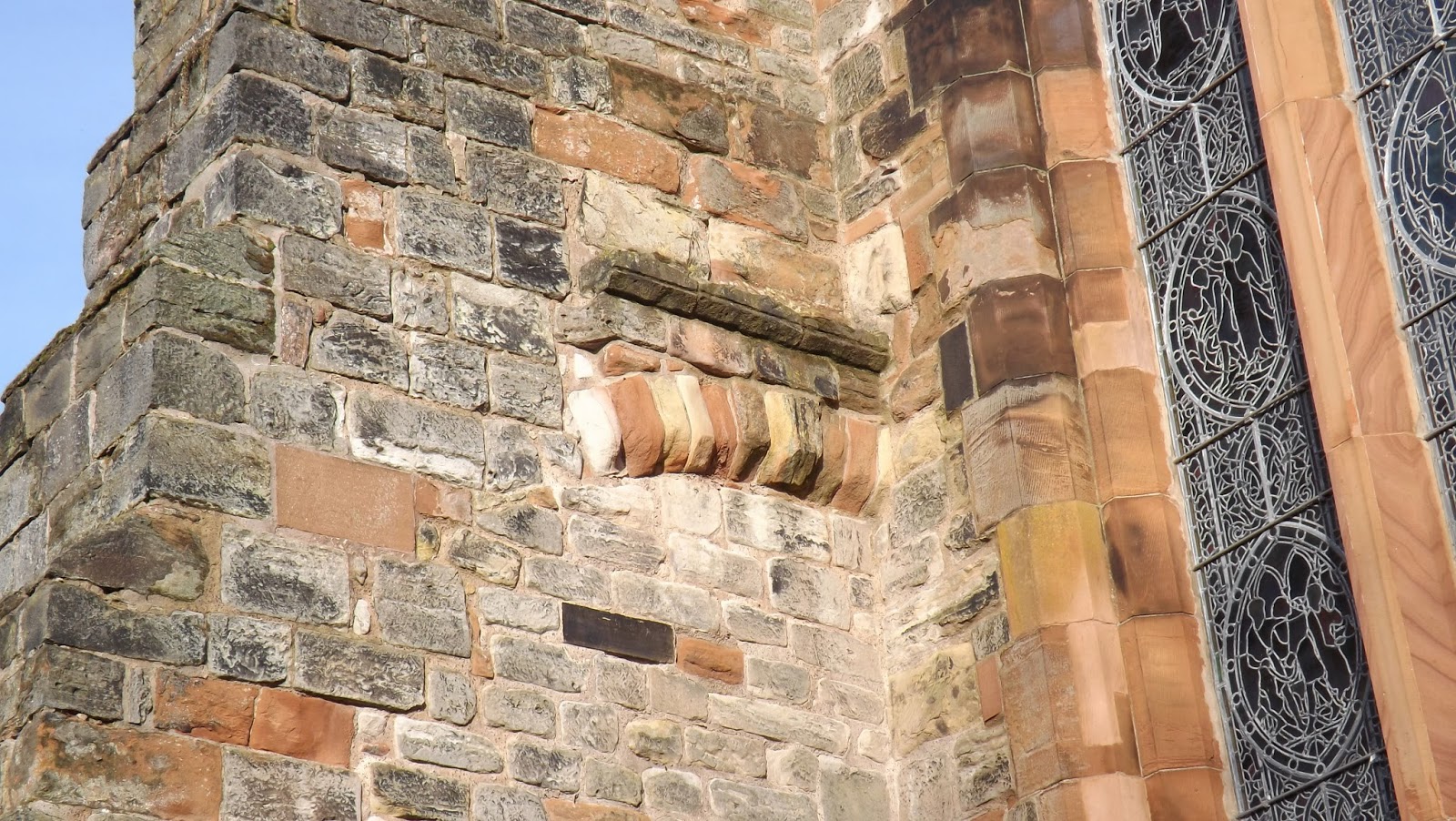
Above. Norman stone work visible high on the South walls of the Cathedral.

Above. Buttress on the West end stub of the Cathedral.

Above. Remains of an arch(?) in the stub of the West end of the Cathedral.


Above. John Coney engraving of Carlisle Cathedral.

Above. M.E.Nutter engraving of Carlisle Cathedral. 

Above. Engraving of Carlisle Cathedral showing the building before its partial demolition by Jacobite forces in 1644. 

Above. Antiquarian floor plan of Carlisle Cathedral.

Friday, 31 October 2014

Stained Glass at St Cuthberts, Carlisle

Stained Glass
St Cuthberts
Carlisle
Cumbria

St Cuthberts has a small but perfectly formed collection of stained glass, all dating from the 20th century, excepting of course the window containing the sole relics of the Norman church on this site.

Above. Stained glass window gifted to the church by the Latvian community.

The Latvian window was made by local firm, Elders, Walker and Millican Ltd, and was dedicated in 1982. The design was by John Rees.

Above. Window dedicated to the memory of James French Fearnley, Eric Henry Rennie and William Foster Woodhouse Telford....all of whom died in World War 2

Above. Window dedicated to Margaret Hodgkinson, mother of Joan. The window shows St Cuthberts and the Cathedral in the background.

Known as the St Mary window, this window was designed by R. R. Nichol.

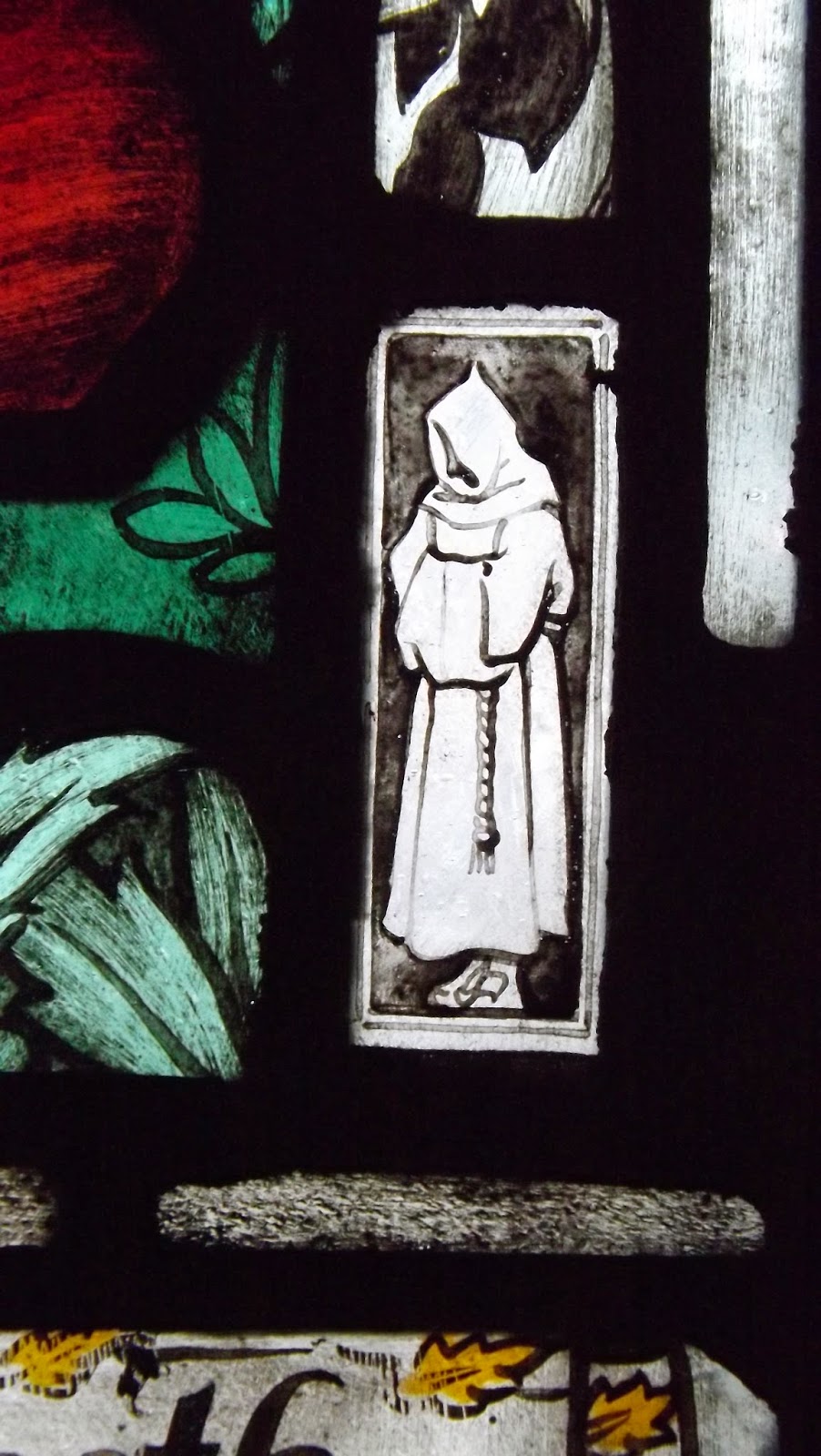
Above. Collection of medieval glass.

This window is contains the only relics of the Norman church that once stood on this site and was demolished in 1778. It was assembled by the Glaziers of York Minster in 1961. The window is dedicated to Mary Annie Edgar (1874 to 1959) and her brother William (1877 to 1945) 

The following set of six windows shows the story of St Cuthbert's life, and all were designed by Nicholson Studios of London.

Above. Window dedicated to John Robert Cockbain, Choir Master and First Secretary of the Parochial Church Council.

The window shows Queen Etheldreda offering St Cuthbert a Stole and Maniple (liturgical vestments) 

Above. Window dedicated to Harold Beesley Wilson M.A., Hon. Canon of Carlisle and Vicar of the Parish from 1927 until 1956.

This window shows St Cuthbert being shown the Roman Well in Carlisle, when he visited in 685AD.

Above. Window dedicated to Benjamin Richmond Rickerby, Churchwarden from 1921 to 1923.

This window shows St Cuthbert of Lindisfarne....patron saint of the North of England, Great Master at Ripon Monastery, monk, hermit, Prior of Melrose, Prior of Lindisfarne and finally Bishop of Lindisfarne.

Above. Window dedicated to Ernest Millican Bulman and Margaret Bulman.

This window shows Prior Boisil of Melrose giving his ring of office to St Cuthbert, his successor.

Above. Window dedicated to James Nelson and Jane Nelson his wife.

This window shows St Cuthbert demonstrating his hospitality whilst the steward of Ripon Monastery.

Above. Window dedicated to Dr Henry Barnes M.D. 

This window shows St Cuthbert being received at Melrose as a young boy.


Carlisle, St Cuthberts

St Cuthberts
Carlisle
Cumbria

Above. St Cuthberts....the shyest church I've ever seen.

Above. Looking into the Chancel from the Nave.


Above. Looking into the Nave with its galleries.

Above. The Chancel and East window.

Above. St Cuthberts from Blackfriar Street.


Above. St Cuthberts from further down Blackfriar Street.


Sunday, 19 October 2014

News flash - Kendal Town Council announce bid to have Kendal Parish church raised to Minster status

Kendal Town Council have announced a bid to have Kendal Parish church raised to Minster status. This move, if successful, would raise Kendal's parish church to the same status as York Minster for example, and place it amongst 44 other 'Greater' churches nationally.


If the bid is successful, and it's currently with the Bishop of Carlisle for his deliberation, Kendal's Parish church will join the likes of Westminster in London, Beverly Minster, Ripon Cathedral, Lincoln Cathedral and of course, the mighty York Minster. To be amongst such illustrious company can only be a good thing for Kendal and the South Lakeland area as a whole, and would certainly be befitting of such a fantastic building, built on such a grand scale and possessing a multitude of important architectural details and furnishings. 


Check the Westmorland Gazette's story out for more information.


Tuesday, 22 April 2014

Casterton, Holy Trinity

Casterton
Holy Trinity
Cumbria

Holy Trinity was built between 1831 and 1833 after being commissioned by the Rev. William Carus Wilson. It is thought likely that the church was built to designs laid down by Kendal architect George Webster, with the tiny, out of proportion, chancel built to designs by Lancaster architect E.G. Paley in 1860.


This is a church of strange proportions....indeed the chancel is a strange addition to the end of the nave, and Nikolaus Pevsner, the famous historical architect, stated that he considered the tower to be 'undersized'. It's certainly not one of George Webster's most inspiring creations, especially when compared to churches in nearby Kendal such as St George on Castle Street and St George and Holy Trinity on New Road, with their large interiors and towering spires. 

The interior of the church contains some important items, unfortunately not seen on my visit. The reredos date from 1897, and were designed by Austin and Paley of Lancaster, and there is some stained glass in the baptistry dating from 1884, and created by Shrigley and Hunt. There is also a composition of wall paintings and stained glass in the Chancel, created between 1893 and 1899 by pre-raphaelite painter Henry Holiday....famous for being commissioned by Lewis Carroll in 1874, to illustrate his story, The Hunting of the Snark. The Nave contains paintings by James Clark, and created over 7 years between 1905 and 1912. The church was closed when I visited back in 2007, so a fresh visit will be required at some point in the future, especially to photograph the wealth of treasure within.

Saturday, 19 April 2014

News - St Mary and St Michael welcomes home oldest chimable bell in UK.

News - St Mary and St Michael in Great Urswick has welcomed home two of its bells. One is the Harrington bell, rumoured to have been cast sometime around 1420, whilst the second bell has been retuned and re-installed. See the full story here.

For photos of the church, see this page on the Cumbrian Churches blog.


Tuesday, 18 March 2014

Temple Sowerby, St James

St James
Temple Sowerby
Cumbria

Surprisingly, I don't seem to be able to confirm if St James' is a listed building or not. The church was built in 1754, and extended in 1770. 


Above. Looking into the Chancel from the Nave.

Above. Looking into the Nave.


Above. The East\Chancel window showing the crucifixion, by Powell of Whitefriars.


Above. The Annunciation by Powell of Whitefriars.

Above. The mark of Powell of Whitefriars.

Check out this website for more information about these famous and much sought after glass artists.