Tuesday, 18 April 2017

Shap Abbey masonry at Lowther Castle

Shap Abbey masonry
Lowther Castle
Near Penrith
Cumbria

Shap Abbey escaped the early phase of the Henrican dissolution of the Monasteries, but the policy of closure of Catholic ecclesiastical establishments eventually caught up with it in 1540. As the Crown took control of Shap's lands and estates and its wealth, the site was sold off to the Governor of Carlisle. What was left slowly fell into ruin and lay forgotten for decades. During the dying years of the 17th century, stone was quarried from the site to build Shap Market Hall, a building that survives to this day. More stone was taken from the site, ornate and carved column stones, and taken to Lowther Castle, to be incorporated into the Earl of Lonsdale's new country house. With the many rebuilds and remodelling of the Earl's house, some stone was removed from the main building and used in the construction of stair ways in the ornamental gardens to the South. These relics from Cumbria's monastic past, are still visible today.


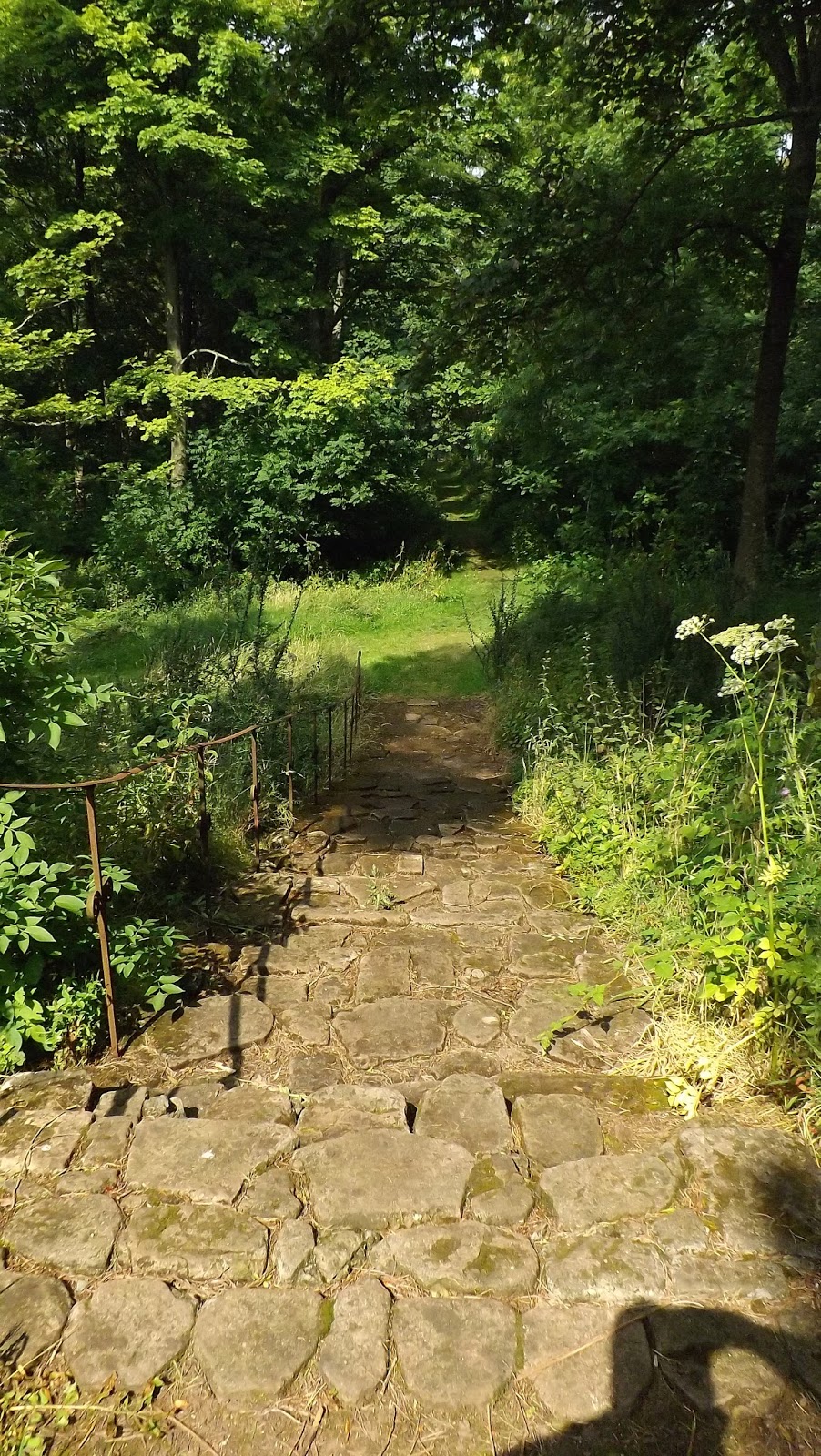

The stairs consist of a mixture of stones taken from ornate piers and columns, and a few bosses that would have topped the decorative columns. There are also a few roughly carved crosses inlaid into the patio area at the top of the stairs near to the Patte d'Oie.

Thursday, 5 January 2017

Thatcham, St Mary

St Mary
Thatcham
Berkshire

Above. View of the tower and South porch.

Above. Tower and yew trees.


Above. View of the church from Church Gate to the East.

Above. The East end of the church.

Above. Norman door in the South porch...and rock legend Ricky Hicks.


Above. View into the choir and Chancel.

Above. View into the North chapel.


Tuesday, 16 August 2016

Bamburgh, St Aiden

St Aiden
Bamburgh
Northumberland

There has most likely been a church here since around AD635, when St Aiden is said to have built a wooden church just beyond the castle's walls. St Aiden of Lindesfarne was an Irish monk who is widely credited with restoring Christianity to Northumbria. He was the first Bishop of Lindesfarne after founding a cathedral there, and travelled extensively across England preaching the gospel amongst the Saxon nobility and the working classes. The period in which St Aiden brought Christianity back to the fore, saw Anglo Saxon pagan beliefs battling for superiority across the country. With the patronage of King Oswald of Northumbria, St Aiden was able to build churches and leave behind a Christian legacy that fulfilled the church's desire to re-establish itself across the North of England, eventually usurping the pagan beliefs that were taking root amongst the towns and villages of the day. 

Above. A view of the church from the West, with the castle in the background.

Bede tells us that St Aiden died here at Bamburgh in AD652, and a beam inside the present day church traditionally is said to be where he was laid when he had died. The building we see today, dates from the late 1100s, with a smattering of pre-1066 stone work in evidence throughout. The Chancel is said to be the second longest in England, and was added in 1230, no doubt to add grandeur to an already important church. 

The best views of the church are to be had from the B1342 travelling West out of Bamburgh. The castle and church look magnificent against the backdrop of the North Sea.

Satterthwaite, All Saints

All Saints
Satterthwaite
Cumbria

I absolutely hate Lakeland slate as a building material....so when I see a church built utilising this unforgiving material it does nothing to endear me to it. That said, I like the form this church takes....squat and sturdy, as if it's bracing itself against the Lakedistrict weather.


Satterthwaite had its own chapel of ease from the late 16th century, with the main parish church being in Hawkshead. The chapel was rebuilt in 1675 by Daniel Rawlinson, from London, from a family living at Grizedale Hall.


The first church was built in 1837 by Montague Ainslie, a local forester and businessman, and later Deputy Lieutenant of Lancashire (1852) It was built in the Early English style, with a narrow, square tower, single bell and gallery over the West end of the church.

All Saints became independent in 1881 and was later renovated at a cost of £450 in 1888. This work saw the roof and windows altered, and the gallery removed. 

In 1914, the church was largely rebuilt, the works costing £1800, and involving the addition of the larger square tower we see today. 

Monday, 11 April 2016

Low Wray, St Margaret

St Margaret
Low Wray
Cumbria

I'm not usually a fan of Victorian architecture....it's mostly staid, functional and a little square for my liking. However....this little church, more of a family\estate chapel really is a Cumbrian gem. It can be found on the drive leading up to Wray Castle, just behind the gatehouse.

Above. St Margaret from the drive way to Wray Castle. 

Built in 1856 by James Dawson, the church was primarily for the use of the family, estate workers and staff at the castle. It was consecrated in 1861. James Dawson, a retired surgeon from Liverpool, established the extensive estates centered around Wray Castle, with the church as its spiritual core, using his wife's fortune.


James died in 1875, and the estates passed to his nephew Preston Rawnsley. Harwick Rawnsley, one of Preston's cousins, served as vicar of St Margarets from 1877.


The church is no longer used for public services and is now in private ownership.

Above. Wray Castle.

Wray Castle lies a few hundred yards away. A visit just to experience this Victorian oddity is highly recommended.